



By Harsh Mestri, Thought Leader in Enterprise AI Strategy & Transformation, 20 November 2026
Why the journey from promising AI pilots to lasting business value starts well before the model.

Most AI initiatives don’t fail. They stall.
The pilot works. The demonstration impresses. The business case gets approved. But when AI meets the realities of a wider organization, the challenges become apparent.
Information sits across disconnected systems. Teams work with different versions of the same numbers. Ownership is unclear. And the value that initially looked promising becomes harder to demonstrate.
Across enterprise transformation engagements, we have seen that the challenge is rarely a lack of ambition or technology. It is the gap between proving that something can work and making it work reliably across the business.
At VCreaTek, we see enterprise AI readiness as a progressive journey, not a checklist of capabilities to tick off before implementation. Lasting impact depends on building the right foundations, executing against real business needs and creating value that can be sustained at scale.
The business challenge: Before AI, establish trust
In one global consumer enterprise engagement, critical business information was distributed across long-standing systems. Sales, Marketing, Finance, and Operations did not always have a consistent view of performance. Reports needed by business leaders could take close to a day to produce, and discussions often began with reconciling different versions of the numbers.
The priority was not to introduce AI. It was to establish a more dependable view of the business.
By bringing information together and strengthening the reporting foundation, the organization reduced the time required to produce revenue reports from nearly a day to minutes. Teams gained a more consistent view of performance, while the consolidation also contributed to reduced overall spending.
The lesson is important: before AI can improve business decisions, organizations need confidence in the information informing those decisions.
“The OECD Digital Government Outlook 2026 highlights how data quality, interoperability and effective governance are essential to trustworthy AI and data-driven operations. These findings reinforce the importance of establishing reliable information foundations before organizations scale AI initiatives.”
Three dimensions of enterprise AI readiness
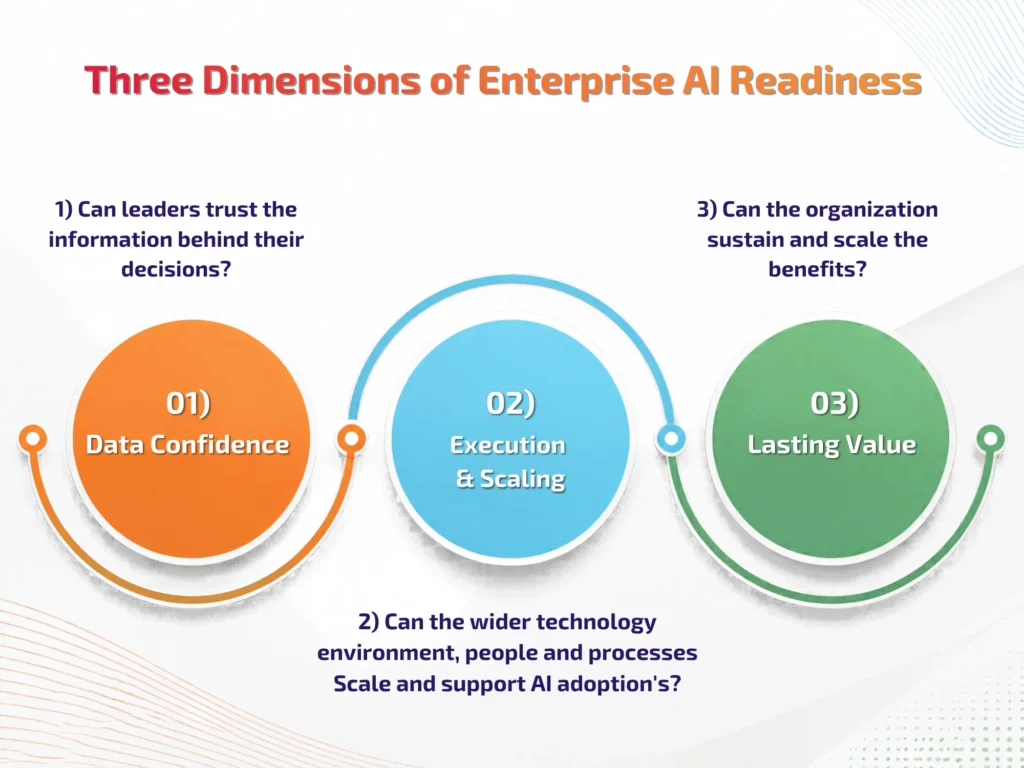
Our perspective on AI readiness is shaped by three interconnected dimensions:
Data Confidence
Fragmented, inconsistent, or inaccessible data creates uncertainty. AI does not eliminate that uncertainty; it can amplify it. Reliable data foundations, quality, and governance are essential.
Practical Execution and Scaling
A promising solution must work within the realities of the enterprise and also scale. Technology creates impact when business priorities, operational processes, and technical capabilities move together.
Lasting Value
A successful launch is only the starting point. Adoption, measurable outcomes and the ability to replicate what works determine whether an AI investment delivers lasting value.
The VCreaTek perspective: Enterprise AI readiness is a funnel
These three dimensions establish what organizations need to get right. The next question is how to progress from readiness to implementation and scale.
At VCreaTek, we view this as a four-stage journey. Each stage builds on the previous one, connecting foundational capabilities with practical execution and measurable business outcomes.
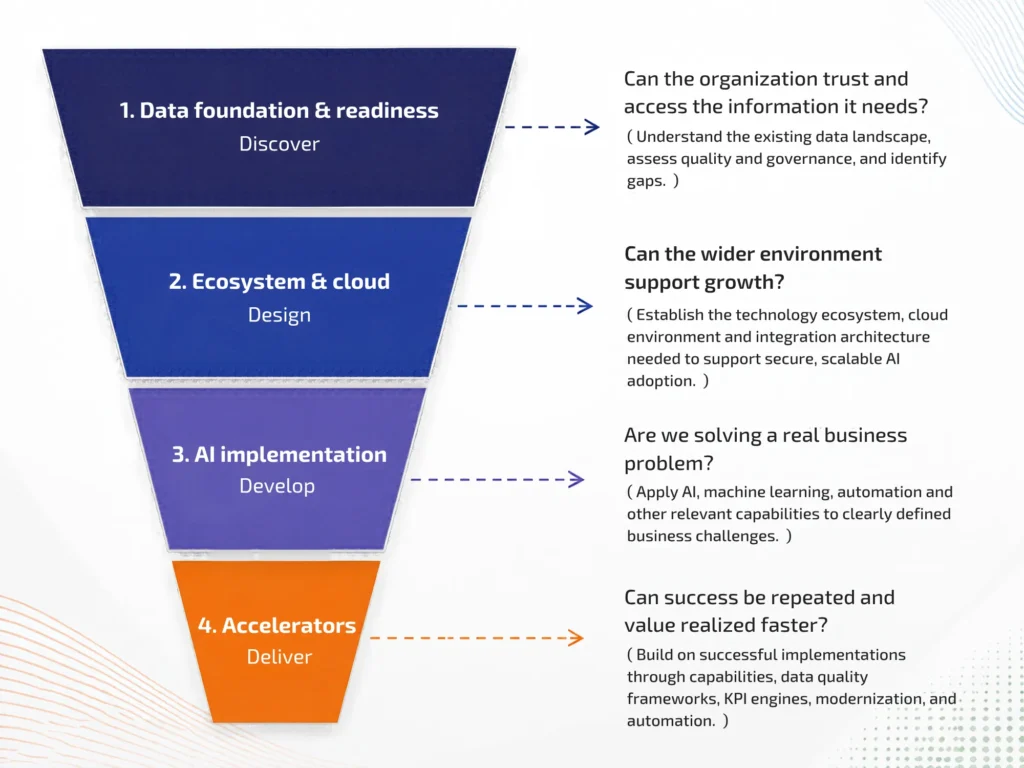
The funnel connects readiness with execution. It helps leaders understand where they are, what needs attention and how to progress without treating AI implementation as an isolated technology project.
From technology to business impact
For enterprise leaders, the questions around AI are evolving.
It is no longer enough to ask what AI can do. Organizations must consider whether they have the foundations to make it work, the capabilities to operationalize it and the ability to demonstrate its value.
At VCreaTek, our approach starts with understanding business priorities, identifying what is getting in the way, and defining what success should look like. We bring together data engineering, analytics, AI and decision intelligence to connect technology with the way businesses operate and make decisions.
The objective is not technology for its own sake. It is to turn data into intelligence, intelligence into better decisions, and those decisions into measurable business outcomes.
Looking ahead
The organizations that make lasting progress with AI will not necessarily be those that move first or adopt the most tools. They will be the ones that build trusted foundations, execute with purpose, and keep business value in view.
The distance between a successful AI pilot and meaningful enterprise impact is where the real transformation happens.
At VCreaTek, that is where we focus: helping organizations move from promising ideas to capabilities that make a difference.
The real measure of AI readiness
AI leadership will not be defined by who adopts it first or deploys the most technology, but by who translates its potential into better decisions, stronger operations and lasting business value.
The real competitive advantage lies in building organizations that can continuously adapt, execute, and scale AI with purpose.
Because success isn’t about adopting AI. It’s about being ready to make AI matter.
Sources and References
The research and external perspectives referenced in this article have been paraphrased and attributed to their original source. No source material has been reproduced in full.
- Organisation for Economic Co-operation and Development (OECD) , Digital Government Outlook 2026: From Foundations to Transformational Impact (2026). OECD Publishing, Paris. View publication i The OECD report examines the foundations needed for trustworthy and scalable digital and AI adoption, including data quality, interoperability, governance, accountability and organizational capabilities.
- OECD, Strengthening Digital Public Infrastructure and Data Governance , a chapter from the Digital Government Outlook 2026. View referenced chapter i This chapter discusses how data quality, interoperability, data sharing and governance support the reliable and scalable use of AI. Although focused on government, the article applies these principles to enterprise AI readiness.
Disclaimer
This article reflects VCreaTek’s independent perspectives on enterprise AI readiness, implementation and business transformation. It is intended solely for general informational and thought-leadership purposes.
External research and findings have been paraphrased and attributed to their respective sources. All third-party content and intellectual property remain the property of their respective owners and are subject to applicable copyright and licensing terms.
The inclusion of any external reference does not imply an affiliation, partnership, sponsorship or endorsement of VCreaTek by the referenced organization.
Readers should consult the original publications for complete context, current information and any applicable terms of use.